See what's on the property that isn't on the file.
Liability Features sweeps your homeowner book once a year from very-high-resolution imagery and flags pools, trampolines, solar arrays and detached structures, keyed to your policy numbers, before the renewal notices go out.
Schematic of what a flag points you to. Not a real policy.
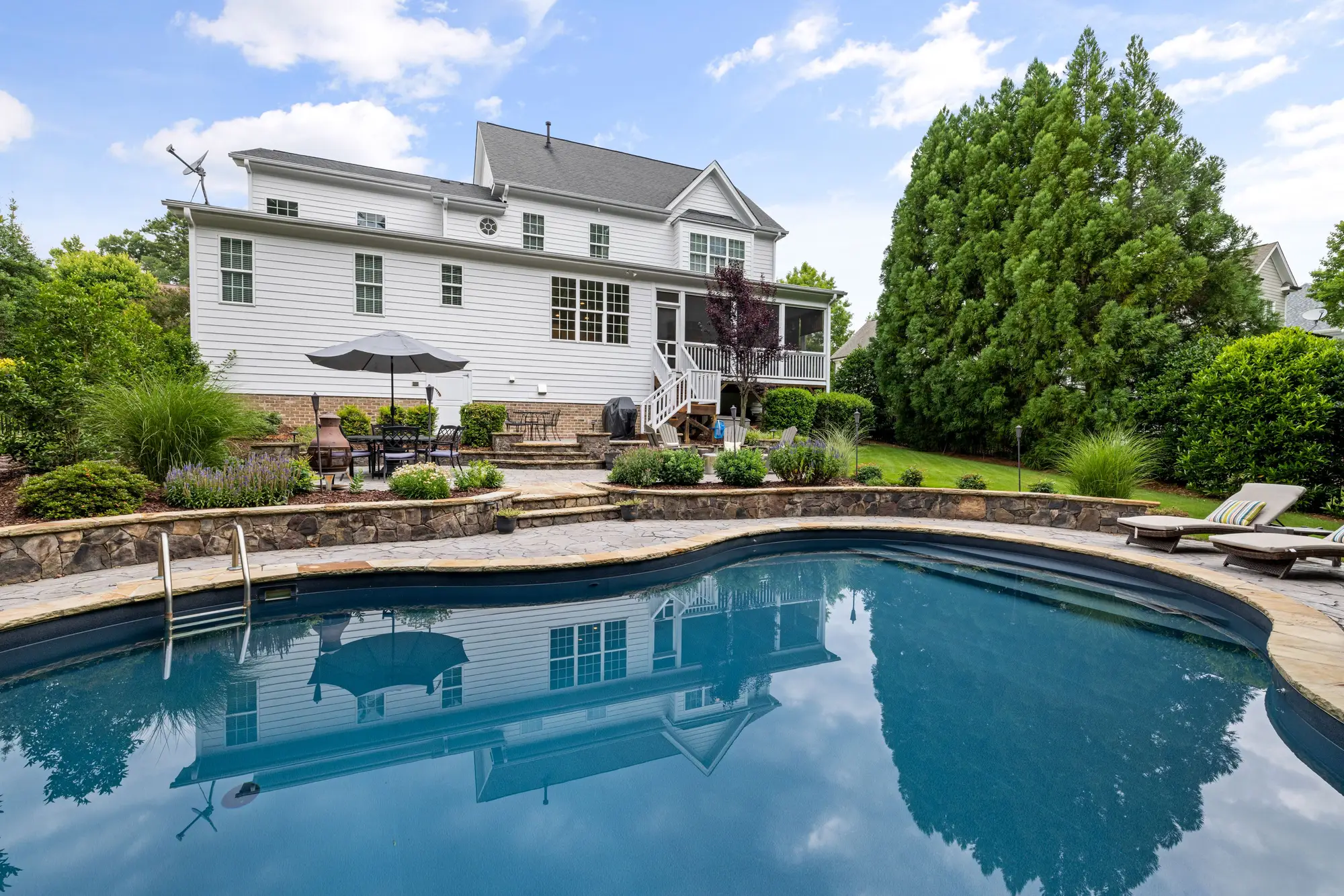
Photo: a backyard pool, seen from the patio.
No. 01
What the file knows at renewal
The renewal underwriter opens the policy file and finds what was true on the day the application was signed. The pool question was answered no. There is an inspection report from some years back, or none. The agent's notes mention a roof. Claims history is clean. Nothing on the file is wrong, and nothing on it is current.
Meanwhile the property changed. A family put in an above-ground pool the summer after they bought. A trampoline went up behind the garage. Someone built a workshop at the back of the lot and someone else put panels on the roof.
None of it reached the carrier, because nobody is asked again, and the policyholder doesn't think of a trampoline as an underwriting event. The policy renews on the old terms. The first time the company hears about the pool is the claim notice.
You can't send an inspector to every address in the book. You can't ask the policyholder to disclose what they don't think matters. What you can do is look at the property from above, once a year, and find out which addresses are worth a call.
No. 02
What comes back
One delivery per annual sweep, in files your underwriting team already opens. To start, it covers the policy list you send.
2.1Feature flagsPer policy
For each address, which of four feature classes are visible: pool, trampoline, solar array, detached structure. A flag means the feature can be seen in the imagery. It says nothing about whether it was declared.
Pool
Trampoline
Solar array
Detached structure
2.2Policy CSVCSV
One row per policy, keyed to your policy number, with the flags alongside it. It loads into the underwriting review worksheet or the referral queue the way any list does.
2.3Sweep mapImage overlay
For each flagged property, the image with the detected features outlined, so the underwriter can see what the flag is pointing at before calling anyone.
2.4Change noteFrom the second sweep
Where earlier imagery exists, the delivery says which flags are new since the last annual sweep. A new pool is a different conversation from a pool that was always there.
No. 03
How it works
1
Send the policy list
Policy numbers and property addresses, as a spreadsheet or CSV. Tell us which lines of business are in it.
2
Imagery
We pull the nearest available VHR satellite or aerial pass for each property, or task a new one where the book needs it.
3
Scan
Each property is scanned for the four feature classes. Addresses the imagery can't read clearly are listed separately instead of guessed at.
4
Delivery
The feature CSV, the overlay images and the list of addresses that carry over to the next cycle. We agree the delivery date against your renewal calendar when the project starts.
No. 04
Ahead of renewal review
Run the sweep before the renewal notices go out. Load the CSV into underwriting review and pull the policies with a flag the file doesn't show. Those get an endorsement conversation, or a referral if your guidelines say so. The rest go through untouched. Nothing changes in your policy administration system: it's a file you load.
A flag is a reason to call. The feature may be new rather than withheld, and what to do about it (a scheduled feature, a rider, a surcharge, a referral) stays with the underwriter.
No. 05
Limits
Presence, not measurement
The sweep sees that a pool is there. It does not measure depth, and it does not check fencing, gates, covers or code compliance.
Resolution floor
At 0.3 m a pixel is about a foot. A pool, a solar array or a garage is many pixels across. A trampoline is a small round shape, and a shade sail, a round patio table or a pool cover can look like one. Sheds and play structures under roughly a trampoline's size may not show at all.
Trees, shade and roofs
Features under tree canopy or in deep shadow are hidden from above. A covered or enclosed pool may not read as a pool. Those addresses are listed separately, not scored on a guess.
Imagery age
We use the nearest available pass. Something built after that pass will not appear until a later one.
Clear-sky window
Optical imagery needs a clear view. Cloud over an address can push it to the next cycle.
Once a year
One sweep a year, matched to renewal. A pool dug in June shows up at the next sweep, not the week it fills.
No. 06
Who it's for
For
Personal lines underwriters reviewing homeowner policies ahead of renewal
Underwriting managers who want the whole book checked for features missing from the file
Teams that load a keyed CSV into their own review worksheet
Not for
Anyone looking for a fraud or misrepresentation finding; a flag is not one
Pool depth, fence or gate compliance, or any measured dimension
Claims investigation on a single loss
Commercial property, or books you can't send as addresses
No. 07
Questions before you start
Does a flag mean the policyholder lied?
No. It means a feature is visible in the imagery and the file doesn't show it. The feature may have been built after the application, or the question may never have been asked again. It's a reason to start a conversation.
What if the imagery is old?
We use the nearest available pass. Construction after that pass won't appear until a later sweep, and the delivery notes which pass each property was read from.
Can you tell pool depth or whether the fence meets code?
No. Detection is presence only.
How do we check it against our own records?
Send a slice of the book where you already know the features, from inspections or claims, and compare our flags with what you hold. Decide from that whether the sweep is worth running across everything.
What happens when it's cloudy over a property?
Optical imagery needs a clear pass. Those addresses are listed and carry over to the next cycle.
How often do you sweep?
Once a year, matched to your renewal cycle.
Will it load into our policy system?
It arrives as a CSV keyed to your policy number, so it opens in a spreadsheet. We don't write into your system.
What about small or rural properties?
Detection works at 0.3 m. Small features and anything under trees or shade structures may be missed, and those addresses are listed so you know what wasn't read.
Who owns the results and the imagery?
Ownership and licence terms for the files and the underlying imagery are written into the agreement before anything is ordered. Ask for them early if your legal team needs to read them.
How is it priced?
The cost depends on the size of the book and the imagery source, and we quote it for your list. Send the list size and the renewal dates and we'll scope it.
Send your renewal book before the next cycle opens.
Tell us roughly how many policies are in the book and when renewals start rolling. We'll say whether the imagery calendar can meet it.